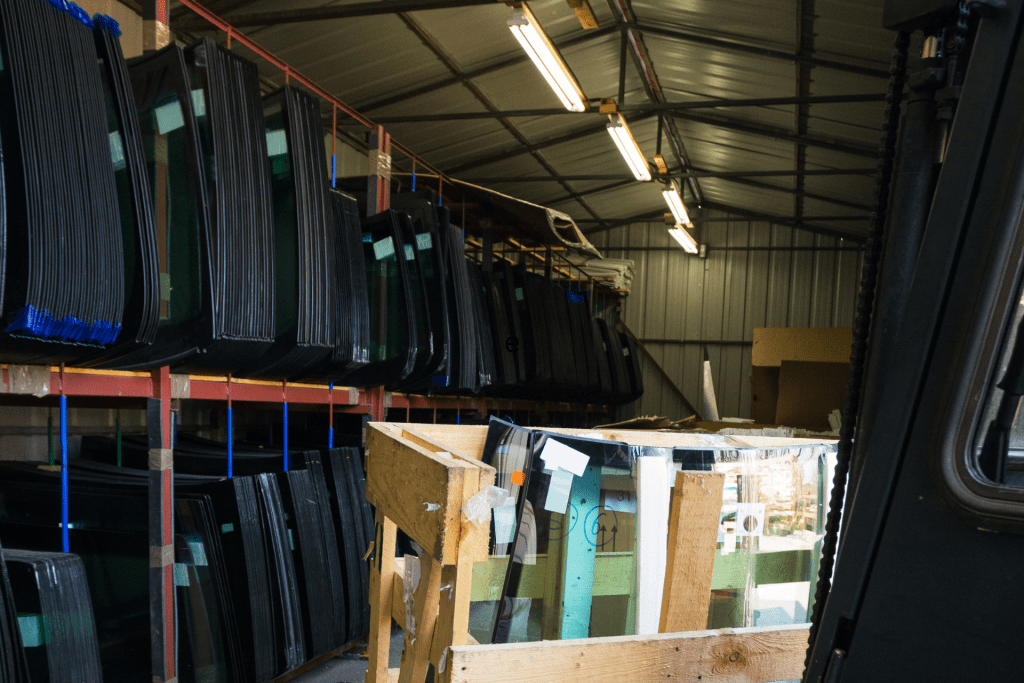

How Auto Glass Is Made: The Fascinating Process Behind Vehicle Safety Glass
Have you ever wondered how your vehicle’s windshield is made or why it breaks differently from a side window?
Automotive glass might look similar to ordinary household glass, but it’s manufactured to meet specific requirements for visibility, durability, and passenger safety.
From the raw materials used to produce glass to the advanced technology found in modern windshields, the manufacturing process involves several carefully controlled steps.
At Boulevard Auto Glass, we don’t manufacture automotive glass, but we work with it every day. Understanding how auto glass is made helps explain why using the correct replacement glass and proper installation methods matters.
What Is Auto Glass Made Of?
Most automotive glass begins with a material called soda-lime glass, produced using a combination of raw materials.
The three primary ingredients are:
- Silica sand: The main source of silicon dioxide, which forms the foundation of the glass.
- Soda ash: Helps lower the temperature required to melt the silica.
- Limestone: Supplies calcium compounds that improve the chemical stability and durability of the finished glass.
Manufacturers may also add other materials to achieve particular colours, properties, or manufacturing requirements.
These ingredients are carefully measured and mixed before being heated to form molten glass.
Step 1: Melting the Raw Materials
The manufacturing process begins in a high-temperature furnace.
The raw materials are heated to temperatures that can approach or exceed 1,500°C, depending on the glass composition and manufacturing process.
As the materials melt, they form a liquid glass mixture.
Manufacturers carefully control temperature and composition to help produce consistent glass with the required optical and physical properties.
The molten glass is then prepared for forming into sheets.
Step 2: Creating Glass Sheets Using the Float Glass Process
Much of the flat glass used in automotive applications is produced using the float glass process.
During this process:
- Molten glass flows onto a bath of molten tin.
- The glass spreads across the tin, forming a smooth, continuous ribbon.
- Manufacturers control the thickness as the glass moves through the production line.
- The glass gradually cools and begins to solidify.
The float process produces sheets with smooth surfaces and consistent thickness.
These properties are particularly important for automotive glass because optical distortion can interfere with a driver’s visibility.
Step 3: Annealing and Cooling the Glass
After the glass is formed, it passes through a controlled cooling process called annealing.
During annealing, the glass is gradually cooled to reduce internal stresses created during manufacturing.
This helps prevent unwanted cracking and prepares the material for further processing.
The finished sheets can then be inspected and cut into the shapes required for different vehicle windows.
However, the glass isn’t ready for installation just yet.
Automotive safety glass requires additional processing.
Step 4: Cutting and Shaping Automotive Glass
Vehicle windows come in many different shapes and sizes.
A windshield for a compact car won’t have the same dimensions or curvature as the windshield of a pickup truck or SUV.
Manufacturers use precision equipment to cut glass to the required dimensions.
Depending on the intended application, the glass may also be heated and curved to match the vehicle’s design.
An important part of the manufacturing process is that cutting and shaping generally occur before the glass receives its final tempering or lamination treatment.
Once glass has been fully tempered, it cannot ordinarily be cut or drilled without breaking.
The next steps depend on whether the glass will become a windshield, side window, rear window, or another automotive component.
Step 5: Manufacturing Laminated Windshield Glass
Most modern vehicle windshields are made from laminated safety glass.
Unlike a single sheet of ordinary glass, a laminated windshield typically consists of two layers of glass bonded around a transparent plastic interlayer.
The interlayer is commonly made from polyvinyl butyral (PVB).
How Laminated Glass Is Made
The manufacturing process generally involves:
- Preparing two glass sheets to match the required windshield shape.
- Placing a PVB interlayer between the glass sheets.
- Removing trapped air and beginning the bonding process.
- Applying controlled heat and pressure, often using an autoclave.
- Inspecting the completed laminated glass for defects and optical clarity.
The result is a bonded glass assembly designed for automotive use.
Why Are Windshields Laminated?
The main advantage of laminated glass is how it behaves when damaged.
If a laminated windshield cracks, the plastic interlayer helps hold the broken glass together.
This reduces the likelihood of the windshield breaking apart into loose pieces and helps maintain a barrier between occupants and the outside environment.
Laminated windshields also contribute to the performance of certain vehicle safety systems, including occupant protection and structural support.
However, a severely cracked windshield may no longer perform as intended and should be professionally assessed.
Step 6: Manufacturing Tempered Automotive Glass
Many vehicle side windows and rear windows are made from tempered safety glass.
Tempered glass is produced using a different process from laminated glass.
How Tempered Glass Is Made
After the glass has been cut and shaped, it undergoes a controlled heat-treatment process.
- The glass is heated to a high temperature, commonly around 600–700°C.
- The heated glass is rapidly cooled using controlled jets of air.
- The cooling process creates compressive stresses near the glass surfaces and balancing tensile stresses within the glass.
This treatment makes the glass more resistant to certain stresses than ordinary annealed glass.
Why Does Tempered Glass Shatter Into Small Pieces?
One of the defining characteristics of tempered glass is its breakage pattern.
When tempered glass breaks, it typically fractures into many small pieces rather than large, sharp shards.
This design helps reduce certain injury risks, although the fragments can still cause cuts.
It’s why a shattered side window often leaves small pieces of glass scattered throughout the vehicle.
Not every modern side or rear window is tempered. Some vehicles use laminated glass in these locations for additional security, sound reduction, or other design requirements.
Laminated vs. Tempered Auto Glass: What’s the Difference?
Both laminated and tempered glass are designed for automotive safety, but they serve different purposes.
| Feature | Laminated Glass | Tempered Glass |
|---|---|---|
| Construction | Glass layers bonded with a plastic interlayer | Single glass sheet strengthened through heat treatment |
| Typical applications | Windshields and some side windows | Many side and rear windows |
| Breakage behaviour | Cracks but often remains held together | Typically breaks into small fragments |
| Repair options | Certain chips and cracks may be repairable | Shattered glass generally requires replacement |
| Main advantage | Retains broken glass and helps maintain a barrier | Improved strength and controlled fragmentation |
The type of glass used depends on the vehicle’s design and applicable safety requirements.
For a more detailed explanation, read our guide to the different types of auto glass.
Step 7: Adding Features to Modern Automotive Glass
Modern automotive glass often includes much more than a transparent surface.
Depending on the vehicle, manufacturers may incorporate additional features during production or finishing.
Tinted and UV-Reducing Glass
Some automotive glass is manufactured with colourants or special coatings that reduce light transmission, glare, or ultraviolet exposure.
Heated Rear Windows
Rear windows frequently contain conductive heating elements that help remove frost and condensation.
These elements may be applied during manufacturing.
Acoustic Glass
Some laminated automotive glass uses specialized interlayers to help reduce noise entering the passenger compartment.
This can contribute to a quieter driving experience.
Heads-Up Display Compatibility
Certain windshields are designed to work with heads-up display systems that project driving information into the driver’s field of view.
These windshields may require specialized construction to reduce unwanted double images.
Rain Sensors and Camera Mounting Areas
Modern windshields may include brackets, coatings, or specially designed areas for rain sensors and vehicle cameras.
Using the correct replacement glass is important because these features must be compatible with the vehicle.
Step 8: Automotive Glass and ADAS Technology
Many newer vehicles use Advanced Driver Assistance Systems (ADAS) to support features such as:
- Lane departure warnings.
- Lane keeping assistance.
- Forward collision warnings.
- Automatic emergency braking.
- Traffic sign recognition.
Some of these systems rely on cameras mounted near or behind the windshield.
Because the cameras must have the correct positioning and view through the glass, replacing a windshield can affect how the systems operate.
Depending on the manufacturer’s requirements, ADAS calibration may be necessary following windshield replacement.
Calibration helps ensure the relevant cameras and systems are correctly aligned and functioning according to the vehicle manufacturer’s specifications.
At Boulevard Auto Glass, we offer in-house ADAS calibration services for applicable vehicles.
Step 9: Quality Control and Safety Testing
Before automotive glass is approved for use, manufacturers perform inspections and testing.
These procedures help confirm that the glass meets applicable requirements for safety and performance.
Optical Clarity
Glass must provide suitable visibility without unacceptable distortion.
This is especially important for windshields, where optical defects can interfere with a driver’s view.
Impact Resistance
Manufacturers test how glass responds to specified impacts.
The required performance depends on the type of glass and the applicable standards.
Breakage Characteristics
Tempered glass may be tested to confirm that it breaks into the required fragment pattern.
Laminated glass may undergo tests relating to penetration resistance, impact performance, and the retention of broken glass.
Dimensions and Fit
Manufacturers check the glass’s dimensions, curvature, and other characteristics to ensure it meets the intended specifications.
Safety Standards
Automotive glass must comply with the safety standards applicable to the market and vehicle.
These standards help establish requirements for visibility, construction, identification, and performance.
Quality control is essential because even small manufacturing defects can affect the suitability of automotive glass.
Can Automotive Glass Be Recycled?
Glass is a recyclable material, but automotive glass recycling can be more complicated than recycling ordinary bottles or jars.
Tempered automotive glass may be processed for reuse where suitable recycling facilities and programs are available.
Laminated windshields are more challenging because the glass must be separated from the plastic interlayer.
Specialized recycling facilities can process certain laminated glass products, but recycling availability varies by location.
Manufacturers are also exploring ways to reduce waste, improve energy efficiency, and recover materials from used automotive glass.
Why Does the Manufacturing Process Matter When Replacing Auto Glass?
Understanding how automotive glass is made helps explain why replacement isn’t simply a matter of installing any piece of glass that fits.
The correct replacement must account for:
- Vehicle make, model, and year.
- Glass dimensions and curvature.
- Laminated or tempered construction.
- Camera and sensor compatibility.
- Heating elements and other integrated features.
- Manufacturer installation requirements.
Professional installation is also important.
A correctly manufactured windshield can still perform poorly if it isn’t installed using the appropriate procedures and materials.
At Boulevard Auto Glass, we provide windshield replacement services in Calgary and help identify the appropriate glass for each vehicle.
Frequently Asked Questions About How Auto Glass Is Made
What materials are used to make car windshields?
Car windshields are typically made from two layers of soda-lime glass bonded together with a plastic interlayer, commonly PVB.
The glass itself is primarily manufactured using silica sand, soda ash, and limestone.
Are all car windows made from the same glass?
No. Most windshields use laminated glass, while many side and rear windows use tempered glass.
Some vehicles also use laminated side or rear windows.
Why don’t windshields shatter like side windows?
Laminated windshields contain a plastic interlayer that helps hold broken glass together.
Tempered side windows are designed to break into many small fragments when they fail.
Can laminated windshield glass be repaired?
Certain chips and limited cracks in laminated windshields may be professionally repaired.
Repairability depends on the size, depth, location, and condition of the damage.
Read our guide on windshield crack repair to learn more.
Can tempered glass be repaired after it shatters?
No. Once tempered glass has shattered into fragments, it generally must be replaced.
Why are some windshields more expensive than others?
Replacement costs can vary because of vehicle-specific glass designs, manufacturing complexity, heating elements, acoustic layers, heads-up display compatibility, and ADAS-related requirements.
For more information, read our auto glass costs and insurance guide.
Is aftermarket automotive glass safe?
Aftermarket glass can be suitable when it meets the applicable safety requirements and the vehicle’s specifications.
The correct part, quality of the glass, and proper installation are all important.
Professional Auto Glass Replacement in Calgary
From raw materials and molten glass to laminated windshields and tempered side windows, automotive glass manufacturing involves precision at every stage.
The result is specially engineered glass designed to provide visibility, protection, and compatibility with modern vehicle technology.
At Boulevard Auto Glass, we understand the importance of choosing the right replacement glass and installing it correctly.
Whether you need a windshield replacement, side window, rear window, sunroof glass, or ADAS calibration, our Calgary team can help.
Need auto glass replacement? Request a Quote from Boulevard Auto Glass or call 587-391-4030 to get started.